
Your competitors just landed another contract. You know why? Because when that procurement manager searched “precision CNC machining near me” last Tuesday, their company showed up on page one. Yours didn’t.
Here’s something that’ll make you sit up straight: 69% of manufacturing leads come from organic traffic. Not trade shows. Not cold calls. Not that expensive booth you rented at the industrial expo. Organic search traffic. And if you’re not showing up in those search results, you’re basically invisible to the people actively looking for what you make.
The manufacturing world has changed faster than most shop floors have kept up with. Engineers and procurement professionals don’t flip through directories anymore. They Google everything. And when they do, the companies ranking on page one are the ones getting the phone calls, the RFQ submissions, and the contracts.
- What is SEO for Manufacturers?
- Why SEO is Non-Negotiable for Manufacturing Companies in 2026
- Advanced Keyword Research for Manufacturing Companies
- On-Page SEO Optimization for Manufacturing Websites
- Technical SEO Essentials for Manufacturers
- Content Marketing Strategy That Drives Leads
- Link Building for Manufacturing Authority
- Local SEO for Regional Manufacturing Markets
- Measuring Manufacturing SEO Success
- Real Manufacturing SEO Results
- Your 90-Day Manufacturing SEO Roadmap
- Stop Losing Leads to Higher-Ranking Competitors

This guide will show you exactly how to get your manufacturing company in front of those buyers. You’ll learn:
- Why traditional manufacturing marketing no longer cuts it (and what works instead)
- The exact keyword strategies that bring qualified leads to your door
- How to measure ROI and track what actually matters
Ready to stop losing leads to higher-ranking competitors? Let’s get your manufacturing company where buyers can actually find it.
Quick Takeaways
| Key Insight | What It Means for Your Business |
|---|---|
| 69% of manufacturing leads come from organic traffic | If you’re not ranking in a search engines results, you’re missing the majority of potential customers who are actively looking for your services |
| SEO leads close at 14.6% vs 1.7% for outbound | Organic search results delivers nearly 9x better conversion rates than traditional marketing methods like cold calling |
| SEO costs 61% lower per lead than outbound marketing | You get higher quality leads at a fraction of the cost of traditional marketing channels |
| 84% of buyers start their search on the internet | Trade shows and referrals alone won’t capture the modern procurement professional who researches online first |
| Most manufacturers see results in 6-12 months | SEO is a long-term investment, not a quick fix, but compounds over time unlike paid advertising |
| Technical content demonstrates expertise | Engineers and procurement managers want detailed specs, tolerances, and processes before they contact you |
| Each service needs its own dedicated page | Google matches specific search engines queries to specific pages, not generic “services” pages |
| Local SEO matters even for national manufacturers | Regional searches often convert better because buyers prefer local suppliers for faster turnaround |
| Investment ranges from $3,000-$8,000 monthly | With manufacturing deals worth $50K-$500K+, even one extra qualified lead per month justifies the cost |
| Link building through industry directories works | ThomasNet, trade associations, and industry publications provide valuable backlinks that boost authority |
What is SEO for Manufacturers?
SEO for manufacturers isn’t the same as SEO for, say, a pizza shop or a clothing brand. The buying process is completely different. When someone searches for “custom injection molding,” they’re not impulse shopping. They’re researching suppliers for a project that might be worth hundreds of thousands of dollars.
Manufacturing SEO is about making your company visible when engineers, procurement managers, and plant operators search for the products and services you offer. It’s getting your website to rank high enough in Google that these decision-makers actually see you before they see your competition.
The thing is, B2B manufacturing searches look different from consumer searches. Someone might search for “aluminum extrusion manufacturer ISO certified” or “precision sheet metal fabrication aerospace.”” These are specific, technical queries from people who know exactly what they need. Your SEO strategy has to match that specificity. If you’re new to this, understanding what is SEO and how it applies to manufacturing will help you grasp why this matters so much.
Why Traditional Marketing No Longer Works Alone
Remember when trade shows were the primary way manufacturers found new customers? Those days aren’t completely gone, but they’re fading fast. Here’s the reality: 84% of people searching for manufacturing services start on the internet.
The shift happened gradually, then all at once. Younger procurement professionals, the ones making buying decisions now, grew up Googling everything. They research online first, narrow down their options, and only then do they reach out. If you’re not visible during that initial research phase, you never make it onto their shortlist.
Trade shows still matter. Referrals still count. But they’re no longer enough on their own. Your potential customers are doing 12 or more searches before they ever contact a supplier. That’s 12 opportunities for them to find your competitors instead of you. This is where local SEO strategies become critical, especially for manufacturers serving regional markets.
Why SEO is Non-Negotiable for Manufacturing Companies in 2025
Let’s talk numbers, because the case for manufacturing SEO isn’t just compelling, it’s overwhelming.
That 69% of leads from organic traffic we mentioned? That’s not a typo. When you compare that to other channels, the gap gets even more dramatic. SEO leads close at 14.6%, while outbound marketing leads close at just 1.7%. Think about that for a second. SEO leads are nearly nine times more likely to convert than leads from traditional marketing outbound methods.
| Channel | Lead Close Rate | Cost Efficiency |
|---|---|---|
| SEO/Organic Search | 14.6% | 61% lower cost per lead |
| Outbound Marketing | 1.7% | Baseline cost |
| Trade Shows | Variable | High event costs |
And here’s another stat that should make your CFO pay attention: SEO costs 61% less per lead than outbound marketing. You’re getting better leads at a fraction of the cost. That’s not just marketing efficiency; that’s smart business. When evaluating your marketing budget, the comparison of SEO vs PPC shows why organic search delivers superior long-term value for manufacturers.
The Real Cost of Invisibility
Let’s flip the question. What does it cost you NOT to invest in SEO?
Every time a qualified buyer searches for what you make and doesn’t find you, that’s a missed opportunity. They’re finding someone else instead. Maybe a competitor who’s been investing in SEO. Maybe a company that isn’t even as qualified as you are but happens to show up first.
Those trade shows you’re spending $15,000 per event to attend? The ROI keeps shrinking. Not because trade shows don’t work anymore, but because buyers are making their shortlists before they ever walk the show floor. If you’re not on that list already, meeting at a booth isn’t enough.
And here’s the uncomfortable truth: procurement professionals under 40 expect to find you online. If they can’t, they question whether you’re still in business, whether you’re up to date with modern manufacturing practices, whether you’re the kind of partner they want to work with.
Advanced Keyword Research for Manufacturing Companies
Keywords in manufacturing fall into different buckets, and understanding which bucket you’re targeting makes all the difference.
Transactional keywords signal buying intent: “custom metal fabrication quote,” “CNC machining services pricing,” “injection molding manufacturer quote.” These searchers are ready to talk business.
Informational keywords capture people earlier in the journey: “difference between injection molding and 3D printing,” “what is precision sheet metal,” “how to choose a contract manufacturer.” These searches come from engineers doing research, comparing processes, learning about solutions.
Technical specifications are a completely different category. Someone searching “6061 aluminum extrusion supplier” or “ISO 9001 certified precision machining” knows exactly what they need. These are gold-mine keywords because the intent is crystal clear.
Strategic Keyword Research Process
Starting keyword research for a manufacturing company means thinking like your customers, not like your sales team. Your sales team might call it “precision manufacturing services.” Your customers might search “tight tolerance machining.” Both are right, but only one matters for SEO, search engines, and lead generation.
Tools like Google Keyword Planner, Ahrefs, and SEMrush help you find these discrepancies. Plug in your service terms and see what actual search volume looks like. Often you’ll discover that the formal industry terminology has a lower search volume than the practical terms engineers actually use.
Don’t ignore your competitors’ rankings or domain authority. Use Ahrefs or SEMrush to see what keywords your competition ranks for. Sometimes you’ll find gaps, keywords they haven’t targeted that represent real opportunities.
Manufacturing-Specific Keyword Categories
| Keyword Type | Example | Search Intent |
|---|---|---|
| Product Keywords | “CNC turning services” | Direct service search |
| Process Keywords | “5-axis CNC machining process” | Educational/comparison |
| Material Keywords | “stainless steel fabrication” | Specific application |
| Industry Keywords | “aerospace parts manufacturer” | Niche specialization |
| Location Keywords | “metal fabrication Houston” | Regional preference |
Each category serves a different purpose in your SEO strategy. Product keywords drive direct conversions. Process keywords build authority. Material and industry keywords target specific buyer segments. Location keywords capture regional markets.
On-Page SEO Optimization for Manufacturing Websites
Most manufacturing websites make the same mistake. They lump everything under a generic “Services” page or “Capabilities” section. That’s terrible for on-page SEO and even worse for user experience.
Each service, each product category, deserves its own dedicated page. If you offer CNC machining, injection molding, and sheet metal fabrication, that’s three separate pages minimum. Probably more, because CNC machining itself can break down into CNC turning, milling, 5-axis machining, and so on.
Why does this matter? Because Google matches search queries to specific pages. When someone searches “precision CNC turning,” Google wants to show them a page specifically about CNC turning, not a general capabilities page that mentions turning among fifteen other services.
Essential On-Page SEO Elements
Title tags and meta descriptions might seem like small details, but they’re your first impression in search results. A good title for a CNC machining page isn’t “CNC Services | YourCompany.” It’s “Precision CNC Machining Services | Tight Tolerance Parts | YourCompany.”
Headers (H1, H2, H3 tags) create structure. Your H1 should include your target keyword naturally. H2s and H3s break up the content and target related terms. “CNC Machining Services” might be your H1, with H2s like “5-Axis CNC Machining,” “CNC Turning,” and “Quality Control Standards.”
Technical details matter in manufacturing. Don’t shy away from specs, tolerances, materials, and processes. Engineers searching for suppliers want to see technical depth. Include tolerance ranges, material options, certifications, and capabilities. Your site’s structure and responsive design play a huge role here, which is why understanding web design for SEO is essential for manufacturing websites.
User Experience for Industrial Buyers
Mobile optimization is now required. Engineers research suppliers from job sites, plant floors, and their phones between meetings. If your site doesn’t work smoothly on mobile, they’re hitting the back button.
Page speed matters more in manufacturing than you’d think. Technical product catalogs can get heavy with high-resolution images and PDFs. Compress those images. Optimize your site’s code. A site that takes eight seconds to load is a site people abandon.
Calls-to-action need to be obvious:
- “Request a Quote” buttons on every service page
- Easy-to-download spec sheets and technical PDFs
- Clear contact information above the fold
- Simple forms that don’t ask for unnecessary information
Video demonstrations work incredibly well for manufacturing. Show your process, your equipment, your quality control. It’s content Google loves, and it’s what engineers want to see before they reach out.
Technical SEO Essentials for Manufacturers
Site speed isn’t just about user experience; it’s a ranking factor. Manufacturing websites often struggle here because of large product catalogs, high-resolution images, and downloadable PDFs. Use tools like Google PageSpeed Insights to see Google analytics and identify what’s slowing you down, then fix it.
Mobile-first indexing means Google primarily uses your mobile site for ranking. If your desktop site is great but your mobile site is clunky, your rankings suffer. Test your site on actual mobile devices, not just resizing your browser window.
HTTPS security is non-negotiable. That little padlock in the address bar signals trust, both to users and to Google. If your site still uses HTTP, switching to HTTPS should be priority one.
Common Technical Issues and Fixes
Duplicate content plagues manufacturing sites. Multiple product pages with nearly identical specs, service pages that repeat the same information with minor variations. The fix is consolidating similar pages or using canonical tags to indicate which version is primary. Understanding duplicate content issues and how to resolve them is critical for manufacturers with large product catalogs.
Crawl errors pop up when Google can’t access parts of your site. Broken links, pages that redirect incorrectly, server errors that block Google’s crawlers. Google Search Console shows you these errors; fixing them should be part of regular site maintenance. Avoiding these pitfalls means steering clear of common SEO mistakes that tank your rankings.
PDF optimization matters because spec sheets and technical documents are central to manufacturing marketing. Make sure PDFs have descriptive filenames, are compressed for faster loading, and include text that search engines can read.
Content Marketing Strategy That Drives Leads
Comparison guides answer questions buyers actually have. “Injection Molding vs. 3D Printing: Which is Right for Your Production Run?” or “5-Axis vs. 3-Axis CNC Machining Compared.” These articles target informational searches and position you as an expert.
Technical how-to content marketing addresses specific pain points. “How to Specify Tolerances for Precision Machining” or “Choosing the Right Aluminum Alloy for Your Application.” Engineers search for this kind of practical guidance constantly.
Case studies prove you can deliver. Don’t just list services; show how you solved specific problems for specific clients. Numbers matter. “Reduced production time by 30%” is more compelling than “improved efficiency.”
Video content marketing dominates engagement. 68% of B2B buyers prefer video format. Film your manufacturing process, interview your engineers, demonstrate quality control. It doesn’t need Hollywood production values; authenticity matters more.
Content Marketing That Demonstrates Expertise
Showcasing your unique manufacturing processes sets you apart. Most manufacturers do roughly similar work, but how you do it, your specific equipment, your quality controls, these are differentiators. Explain them.
Technical concepts can be accessible without being dumbed down. Engineers respect clear explanations that don’t sacrifice accuracy. Break down complex processes into logical steps. Use diagrams. Define specialized terms when you first use them.
Educational content marketing builds trust faster than promotional content marketing. Answer questions without immediately asking for the sale. Be genuinely helpful. The ROI comes later when that engineer who read your article six months ago remembers your company when it’s time to request quotes.
Link Building for Manufacturing Authority
Industry directories like ThomasNet, Thomasnet.com, and GlobalSpec aren’t just lead sources; they’re valuable backlinks. Complete profiles on these platforms, keep them updated, and make sure they link back to your website.
Trade association memberships come with benefits beyond networking. Most associations have member directories on their websites, and those are legitimate, relevant backlinks from authoritative industry sources. If you’re wondering what backlinks are and why they matter so much, they’re essentially votes of confidence from other websites that tell Google your site is trustworthy.
Quality beats quantity in link building. One backlink from a respected industry publication carries more weight than dozens of backlinks from random directories no one’s heard of.
Practical Link Building Tactics
- Industry publication features: Getting quoted in trade magazine articles or contributing expert commentary typically includes a backlink to your site.
- Guest posting: Write for manufacturing blogs and industry websites your customers actually read.
- Local directories: Claim local directories on your Business Profile, local chambers of commerce, and regional business directories.
- Press releases: New equipment, expanded capabilities, major contracts (when you’re allowed to publicize them) are newsworthy events.
- Supplier relationships: If you supply components to larger manufacturers, can they list you as a trusted supplier on their site?
Local SEO for Regional Manufacturing Markets
Google Business Profile optimization is critical for manufacturers serving local or regional markets. Claim your Google Business profile, complete every field, add photos of your facility and work, and keep your information current.
Local keywords matter even for B2B manufacturers. “Examples include “Metal fabrication Houston,” “precision machining Atlanta,” and “contract manufacturing Chicago.”” People search with location modifiers when they prefer or require local suppliers. Understanding why businesses need local SEO helps you recognize that even large manufacturers benefit from local visibility.
NAP (Name, Address, Phone Number) consistency across directories signals legitimacy to Google. The information on your Google Business Profile should be identical to everywhere this info appears online, from your website to directory listings to social media profiles.
Customer reviews and testimonials on local directories influence local search engines rankings. Encourage satisfied customers to leave reviews on your Google Business Profile. Respond to reviews professionally, both positive and negative.
Measuring Manufacturing SEO Success
Organic traffic growth is the most obvious metric. Month-over-month and year-over-year comparisons show whether your SEO efforts are moving the needle. But raw traffic numbers don’t tell the whole story.
| Metric | What It Measures | Why It Matters |
|---|---|---|
| Organic Traffic | Visitors from search engines | Overall visibility trend |
| Keyword Rankings | Position for target terms | Competitive standing |
| Conversion Rate | Form fills, calls, quotes | Lead quality |
| Cost Per Lead | SEO investment ÷ leads | Efficiency vs. other channels |
| Revenue Attribution | Closed deals from SEO | True ROI |
RFQ and quote form submissions are conversion events. If organic traffic is growing but conversions aren’t, something’s wrong. Maybe you’re attracting the wrong traffic. Maybe your conversion process needs work.
Phone call tracking reveals another conversion path. Not every B2B buyer fills out forms. Many prefer to call directly. Use call tracking numbers to attribute phone leads to organic search traffic. Calculating the ROI of SEO requires tracking these conversions all the way through to closed deals.
Tools You Need
Google Analytics 4 is your foundation for tracking website behavior. Set up goals for quote requests, downloads, and other conversions. Create custom reports that show organic traffic performance specifically.
Google Search Console provides insights straight from Google. See which keywords trigger impressions and clicks. Identify pages that rank well and pages that need work. Monitor technical issues that could hurt rankings.
Position tracking tools like SEMrush or Ahrefs monitor keyword rankings automatically. Track your rankings and your competitors’ rankings side by side.
Real Manufacturing SEO Results
Real numbers from real companies make the case better than any theoretical argument. While your results will vary based on competition, investment, and execution, these examples show what’s possible.
One precision manufacturing company achieved a 206% increase in organic traffic over 12 months through comprehensive SEO strategy. They focused on creating detailed service pages for each manufacturing process, published regular technical content, and built a quality backlink profile through industry relationships.
A contract manufacturer saw 136% improvement in conversion rates after optimizing their website for user experience and conversion. The fix wasn’t rocket science: clearer calls-to-action, simplified quote request forms, and better technical information that answered common customer questions.
Industrial equipment manufacturers typically see results within 6-12 months of consistent SEO work. The timeline reflects the long sales cycles and technical complexity of B2B manufacturing. Quick wins happen in months 3-6; substantial results show up around month 9-12.
What These Results Mean for Your Business
Expected timeline for results requires patience. Don’t expect page one rankings in 30 days. Month one is foundation-building: audits, keyword research, initial optimization. Month two through six is content creation and technical fixes. Month six through twelve is when rankings improve and leads increase substantially.
Investment versus return benchmarks in manufacturing show strong ROI. Most manufacturers invest $3,000-$8,000 monthly for comprehensive SEO services. With average B2B manufacturing deals worth $50,000 to $500,000 or more, even a few additional qualified leads per month justifies the investment.
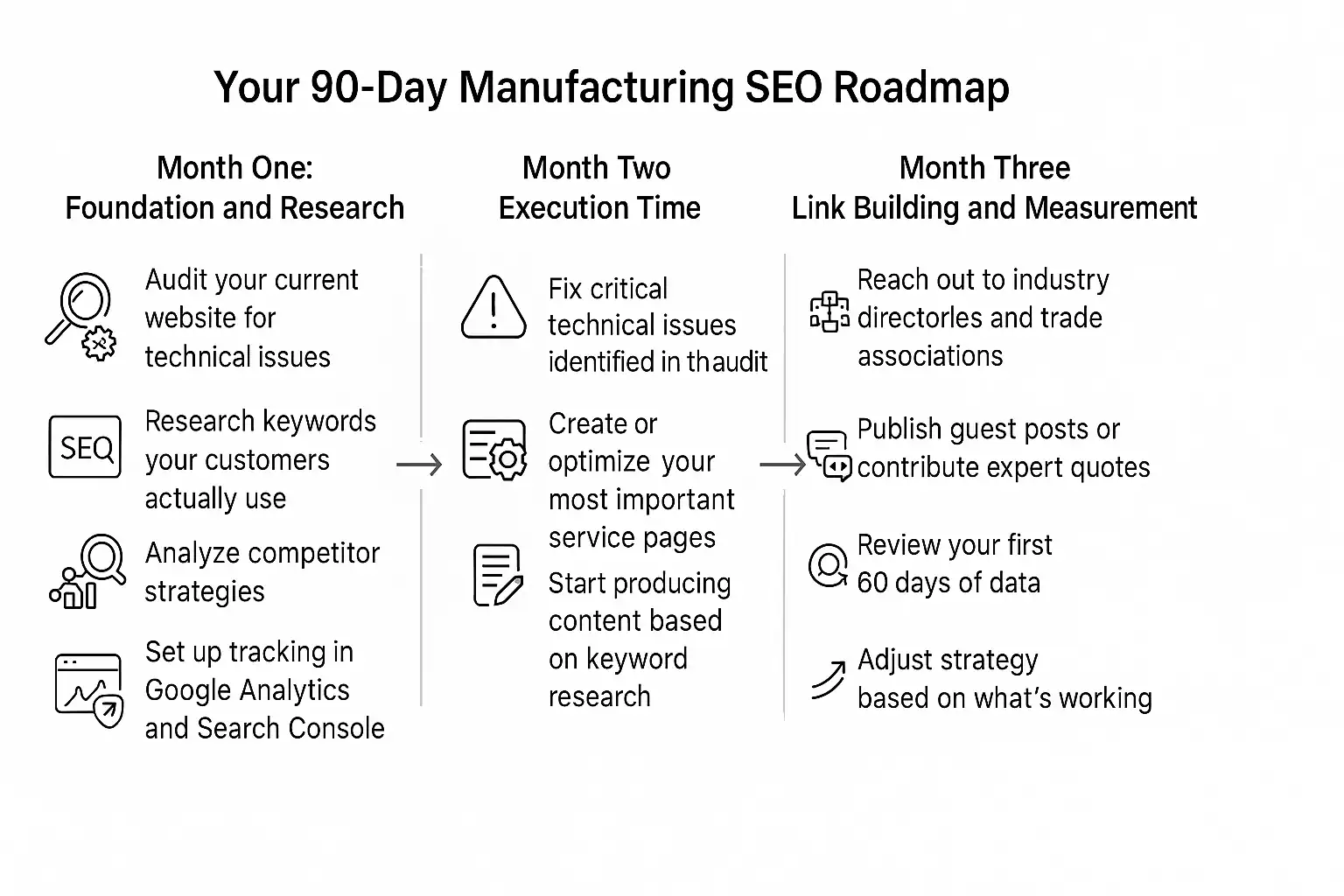
Your 90-Day Manufacturing SEO Roadmap
Month One: Foundation and Research
- Audit your current website for technical issues
- Research keywords your customers actually use
- Analyze competitor strategies
- Set up tracking in Google Analytics and Search Console
Month Two: Execution Time
- Fix critical technical issues identified in the audit
- Create or optimize your most important service pages
- Start producing content based on keyword research
- Set up or claim your Google Business Profile
Month Three: Link Building and Measurement
- Reach out to industry directories and trade associations
- Publish guest posts or contribute expert quotes
- Review your first 60 days of data
- Adjust strategy based on what’s working
Ongoing optimization never stops. SEO isn’t a project you complete; it’s a process you maintain. Continue creating content, building links, monitoring rankings, and refining your approach based on data. When you reach the point where you need external expertise, knowing how to choose your SEO agency ensures you partner with someone who understands manufacturing.
Stop Losing Leads to Higher-Ranking Competitors
The manufacturing landscape has changed. Buyers research online before they ever pick up the phone or walk a trade show floor. If you’re not visible in those searches, you might as well not exist.
SEO for manufacturers isn’t mysterious, and it’s not optional anymore. It’s how modern B2B buyers find suppliers. Companies investing in SEO now are capturing leads their competitors don’t even know exist.
The competitive advantage of early adoption is real. Most manufacturing companies still underinvest in digital marketing. That won’t last forever. The manufacturers building strong organic visibility now will have significant advantages when the industry catches up.
If you’re ready to stop losing contracts to higher-ranking competitors and start capturing that 69% of manufacturing leads that come from organic search and search engine optimization, TheeDigital can help. We’ve built hundreds of websites and generated thousands of monthly leads for manufacturers just like you. Get in touch today and let’s talk about getting your manufacturing company found online.
Real Manufacturing SEO Results
If you’re ready to stop losing contracts to higher-ranking competitors and start capturing that 69% of manufacturing leads that come from organic search and search engine optimization, TheeDigital can help give us a call at 919-341-8901.
Frequently Asked Questions About SEO for Manufacturers
Most manufacturers start seeing measurable improvements within 3-6 months, with substantial results by month 9-12. The timeline depends on your current website state, competition level, and how aggressively you implement SEO strategies. Quick wins like improved site speed optimized title tags, meta descriptions, and Google Business Profile can show results faster, while competitive keyword rankings take longer to develop online visibility.
Manufacturing SEO services typically range from $3,000-$8,000 per month for comprehensive strategies, though this varies based on competition, goals, and scope. Consider that in manufacturing, where average deal sizes range from $50,000 to $500,000+, even one additional qualified lead per month justifies the investment.
Yes, because many B2B buyers prefer or require regional suppliers for faster turnaround, lower shipping costs, and easier collaboration. Even manufacturers serving national markets benefit from local SEO because regional searches often convert better. Plus, local SEO and local keywords is typically less competitive than national terms.
Manufacturing SEO needs more technical knowledge. It also needs longer content about specifications and processes. It requires targeting keywords specific to the industry. The sales cycles are longer, the decision-makers are more technical, and the content needs to demonstrate real expertise rather than just marketing fluff.
Yes. Search engine optimization is one of the few ways small manufacturers can compete well against larger competitors. Small manufacturers often outrank larger companies by focusing on specific niches. They create detailed technical content and target long-tail keywords. Larger companies rely on brand recognition but often ignore SEO.
Tags: Lead Generation • Search Engine Optimization

Richard Horvath
Richard Horvath is the founder of TheeDigital, a Raleigh based award-winning web design and digital marketing agency. He is proud of his team and the results that they provide to their clients.